
Online Database of Chemicals from Around the World
| Survival Technologies Pvt Ltd | India | |||
|---|---|---|---|---|
 | www.survivaltechnologies.in | |||
 | +91 (22) 4212-8221 | |||
 | +91 (22) 4212-8226 | |||
 | info@survivaltechnologies.in | |||
| Chemical manufacturer since 2006 | ||||
| chemBlink Standard supplier since 2009 | ||||
| BOC Sciences | USA | |||
|---|---|---|---|---|
| www.bocsci.com | |||
| +1 (631) 485-4226 | |||
| +1 (631) 614-7828 | |||
| info@bocsci.com | |||
| Chemical manufacturer | ||||
| chemBlink Standard supplier since 2010 | ||||
| Sigma-Aldrich, Inc. | China | |||
|---|---|---|---|---|
| www.sigmaaldrich.com | |||
| +86 (21) 6141-5566 800-819-3336 | |||
| orderCN@sial.com | |||
| Chemical manufacturer since 1992 | ||||
| chemBlink Standard supplier since 2013 | ||||
| wuhan chemi Pharmacy Chemical Technology Co., Ltd. | China | |||
|---|---|---|---|---|
| www.chemipharm.com.cn | |||
| +86 13971619949 | |||
| gmn424@chemipharm.com.cn | |||
 | QQ Chat | |||
 | WeChat: 13971619949 | |||
| Chemical manufacturer since 2014 | ||||
| chemBlink Standard supplier since 2026 | ||||
| Classification | Pharmaceutical intermediate >> Heterocyclic compound intermediate >> Pyridine compound >> Pyridine derivative |
|---|---|
| Name | Pyridine trifluoroacetate |
| Synonyms | Trifluoroacetic acid pyridine salt |
| Molecular Structure | 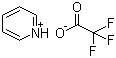 |
| Molecular Formula | C5H5N.C2HF3O2 |
| Molecular Weight | 193.12 |
| CAS Registry Number | 464-05-1 |
| EC Number | 207-345-8 |
| SMILES | C1=CC=NC=C1.C(=O)(C(F)(F)F)O |
| Melting point | 82 - 83 °C (Expl.) |
|---|---|
| Hazard Symbols |  GHS07 Warning Details GHS07 Warning Details | ||||||||||||||||
|---|---|---|---|---|---|---|---|---|---|---|---|---|---|---|---|---|---|
| Risk Statements | H315-H319-H335 Details | ||||||||||||||||
| Safety Statements | P261-P264-P264+P265-P271-P280-P302+P352-P304+P340-P305+P351+P338-P319-P321-P332+P317-P337+P317-P362+P364-P403+P233-P405-P501 Details | ||||||||||||||||
| Hazard Classification | |||||||||||||||||
| |||||||||||||||||
| SDS | Available | ||||||||||||||||
 chemBlink Chemical Story
|
Pyridine trifluoroacetate is an acid–base adduct (salt) formed between pyridine, a basic aromatic heterocycle, and trifluoroacetic acid, a strong electron-withdrawing carboxylic acid. In this compound, the pyridine nitrogen is protonated to form a pyridinium cation, while trifluoroacetate serves as the counterion. The resulting ionic pair is commonly encountered in organic chemistry as a stable, crystalline or solvated salt depending on conditions. Pyridine is a six-membered aromatic heterocycle containing one nitrogen atom. The nitrogen lone pair is not part of the aromatic sextet, making it available for protonation and coordination. This basicity allows pyridine to readily form salts with strong acids such as trifluoroacetic acid. Upon protonation, pyridine becomes pyridinium, which carries a positive charge delocalized over the aromatic ring through resonance, although the nitrogen remains the primary charge center. Trifluoroacetic acid is a strongly acidic carboxylic acid whose acidity is significantly enhanced by the presence of three fluorine atoms on the adjacent carbon. The strong electron-withdrawing inductive effect of the trifluoromethyl group stabilizes the conjugate base, trifluoroacetate, making it a weakly coordinating but highly stable anion. This property makes trifluoroacetate a common counterion in organic and biochemical applications. In pyridine trifluoroacetate, ionic interaction between the pyridinium cation and trifluoroacetate anion dominates the solid-state structure. These ions are typically held together through electrostatic attraction and may also participate in hydrogen bonding interactions involving the acidic proton and carbonyl oxygen atoms of the trifluoroacetate group. Such interactions contribute to the stability of the salt and influence its crystallization behavior. The formation of pyridine trifluoroacetate is a straightforward acid–base neutralization reaction, where pyridine accepts a proton from trifluoroacetic acid. This type of salt formation is widely used in organic synthesis to modulate the reactivity and handling properties of pyridine and related bases. Protonation of pyridine significantly reduces its nucleophilicity while increasing its solubility in polar and protic solvents. From a physicochemical perspective, pyridine trifluoroacetate is expected to be a polar, ionic compound with good solubility in water and other polar solvents. The presence of the trifluoromethyl group imparts additional hydrophobic character compared with simple acetate salts, but the overall ionic nature dominates its solubility profile. In many cases, such salts are used in reaction media or purification steps where controlled acidity and ionic strength are important. In organic synthesis, pyridine is frequently used as a base, catalyst, or nucleophilic scavenger. Conversion to its trifluoroacetate salt effectively suppresses its basic and nucleophilic behavior, which can be useful in reaction workups or in systems where controlled protonation is required. Trifluoroacetate salts are also commonly used in peptide chemistry and protecting group strategies due to the volatility and acidity of trifluoroacetic acid. The trifluoroacetate anion is relatively non-coordinating compared with other carboxylate anions, which makes it useful in reactions involving sensitive cationic intermediates. Its stability and weak nucleophilicity reduce unwanted side reactions, while still maintaining charge balance in ionic compounds. Overall, pyridine trifluoroacetate is a simple acid–base salt formed from protonated pyridine and trifluoroacetate anion. Its significance lies in its role as a stable ionic form of pyridine, its strong polarity, and its utility in organic synthesis where controlled acidity and non-coordinating counterions are required. References 2021. Recent advances in the synthesis of bis(pyrazolyl)methanes and their applications. Research on Chemical Intermediates. DOI: 10.1007/s11164-021-04592-7 2019. Alpha-Casein: an efficient, green, novel, and eco-friendly catalyst for one-pot multi-component synthesis of bis (pyrazol-5-ols), dihydro-pyrano[2,3-c]pyrazoles and spiropyranopyrazoles in an environmentally benign manner. Journal of the Iranian Chemical Society. DOI: 10.1007/s13738-019-01641-2 2017. Efficient synthesis of chromeno[2,3-c]pyrazolyl-pyrazolol(s) in hydrotropic solution and their anti-infective potential. Research on Chemical Intermediates. DOI: 10.1007/s11164-017-3171-5 |
| Market Analysis Reports |