
Online Database of Chemicals from Around the World
| BOC Sciences | USA | |||
|---|---|---|---|---|
 | www.bocsci.com | |||
 | +1 (631) 485-4226 | |||
 | +1 (631) 614-7828 | |||
 | info@bocsci.com | |||
| Chemical manufacturer | ||||
| chemBlink Standard supplier since 2010 | ||||
| Shanghai Forever Synthesis Co.,Ltd. | China | |||
|---|---|---|---|---|
| www.foreversyn.com | |||
| +86 (551) 6288-8437 +86 18096409024 | |||
| sales@foreversyn.com sales02@foreversyn.com | |||
 | QQ Chat | |||
 | Skype Chat | |||
| Chemical distributor since 2013 | ||||
| chemBlink Standard supplier since 2018 | ||||
| wuhan chemi Pharmacy Chemical Technology Co., Ltd. | China | |||
|---|---|---|---|---|
| www.chemipharm.com.cn | |||
| +86 13971619949 | |||
| gmn424@chemipharm.com.cn | |||
| QQ Chat | |||
 | WeChat: 13971619949 | |||
| Chemical manufacturer since 2014 | ||||
| chemBlink Standard supplier since 2026 | ||||
| Classification | Organic raw materials >> Carboxylic compounds and derivatives |
|---|---|
| Name | 4-Formyl-alpha-methylbenzeneacetic acid |
| Synonyms | 2-(4-Formylphenyl)propanoic acid; 2-(4-Formylphenyl)propionic acid; 2-(p-Formylphenyl)propionic acid |
| Molecular Structure | 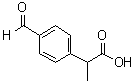 |
| Molecular Formula | C10H10O3 |
| Molecular Weight | 178.18 |
| CAS Registry Number | 43153-07-7 |
| EC Number | 641-460-8 |
| SMILES | CC(C1=CC=C(C=C1)C=O)C(=O)O |
| Solubility | Slightly soluble (1.4 g/L) (25 °C), Calc.* |
|---|---|
| Density | 1.222±0.06 g/cm3 (20 °C 760 Torr), Calc.* |
| Boiling point | 352.3±17.0 °C 760 mmHg (Calc.)* |
| Flash point | 181.0±17.4 °C (Calc.)* |
| Index of refraction | 1.583 (Calc.)* |
| * | Calculated using Advanced Chemistry Development (ACD/Labs) Software. |
| Hazard Symbols |  GHS07 Warning Details GHS07 Warning Details |
|---|---|
| Risk Statements | H302-H315-H319-H335 Details |
| Safety Statements | P261-P264-P264+P265-P270-P271-P280-P301+P317-P302+P352-P304+P340-P305+P351+P338-P319-P321-P330-P332+P317-P337+P317-P362+P364-P403+P233-P405-P501 Details |
| SDS | Available |
 chemBlink Chemical Story
|
4-Formyl-alpha-methylbenzeneacetic acid is an aromatic carboxylic acid derivative containing both an aldehyde functional group and a substituted acetic acid side chain attached to a benzene ring. Structurally, it can be described as a benzeneacetic acid (phenylacetic acid) framework bearing an α-methyl substituent on the side chain and a formyl group at the para position of the aromatic ring. The presence of multiple functional groups makes it a multifunctional intermediate commonly associated with synthetic organic chemistry rather than a widely documented natural product. The benzeneacetic acid scaffold is a well-established structural motif in organic chemistry and is present in a variety of biologically active molecules and pharmaceutical intermediates. Substitution at the α-position of the acetic acid side chain introduces a stereogenic center, which can influence the compound’s reactivity and potential biological interactions. The α-methyl group also increases steric hindrance near the carboxylic acid functionality, which can affect acidity and esterification behavior compared with unsubstituted phenylacetic acid derivatives. The formyl group at the para position of the aromatic ring is an aldehyde functionality that is highly reactive toward nucleophilic addition reactions. Aldehydes are electrophilic carbonyl compounds that readily undergo condensation reactions, such as aldol-type reactions, imine formation with amines, and reduction to alcohols. The para positioning relative to the side chain allows for electronic communication through the aromatic ring, influencing both the reactivity of the aldehyde and the overall electronic distribution of the molecule. The simultaneous presence of a carboxylic acid and an aldehyde in the same molecule introduces the possibility of diverse chemical transformations. Carboxylic acids can undergo typical reactions such as esterification, amidation, or conversion to acid chlorides, while the aldehyde can participate in addition and condensation chemistry. This orthogonal functional group reactivity makes such molecules useful as intermediates in multistep synthetic sequences, where selective transformation of one functional group is required without affecting the other. From an electronic perspective, the benzene ring serves as a conjugated platform that can transmit substituent effects between functional groups. The electron-withdrawing nature of both the carboxylic acid and aldehyde groups influences the electron density of the aromatic system, generally reducing its susceptibility to electrophilic aromatic substitution compared with unsubstituted benzene. The para relationship between the formyl group and the side chain allows for resonance and inductive effects to be distributed across the ring system. In terms of physicochemical properties, 4-formyl-alpha-methylbenzeneacetic acid is expected to be a polar organic compound with limited water solubility in its neutral form due to the hydrophobic aromatic ring and alkyl backbone. However, the carboxylic acid group can form salts under basic conditions, significantly increasing aqueous solubility. The aldehyde group contributes additional polarity but does not typically dominate solubility behavior compared with ionizable groups. Compounds of this general structural type are often used as intermediates in the synthesis of more complex aromatic derivatives, including pharmaceutical candidates, agrochemicals, and fine chemicals. The aldehyde functionality provides a convenient handle for chain extension or heterocycle formation, while the carboxylic acid group enables coupling reactions such as amide bond formation or esterification. The synthesis of substituted benzeneacetic acid derivatives commonly involves Friedel–Crafts-type acylation routes, side-chain functionalization of toluene derivatives, or multi-step oxidation and formylation strategies. The precise synthetic pathway depends on the desired substitution pattern and functional group compatibility. Overall, 4-formyl-alpha-methylbenzeneacetic acid is a multifunctional aromatic compound featuring a para-formyl substituent and an α-methyl-substituted acetic acid side chain. Its significance lies primarily in synthetic organic chemistry, where its dual functional groups enable a wide range of transformations for the construction of more complex molecular architectures. |
| Market Analysis Reports |