
Online Database of Chemicals from Around the World
| Sichuan Tongsheng Amino Acids Co., Ltd. | China | |||
|---|---|---|---|---|
 | www.aminoacid.cc | |||
 | +86 (838) 227-4206 250-8248 | |||
 | +86 (838) 227-4207 | |||
 | amino@vip.sina.com sales@biots.cn | |||
 | QQ Chat | |||
| Chemical manufacturer since 2003 | ||||
| chemBlink Standard supplier since 2007 | ||||
| Zhengzhou Xlinebio Technology Co., Ltd. | China | |||
|---|---|---|---|---|
| www.xlinebio.com | |||
| +86 (371) 6131-8675 | |||
| +86 (371) 6131-8675 | |||
| sales@xlinebio.com | |||
| Chemical manufacturer since 2017 | ||||
| chemBlink Standard supplier since 2018 | ||||
| Nonsensia | Poland | |||
|---|---|---|---|---|
| nonsensia.pl | |||
| +48 506 848 838 | |||
| nonsensia@outlook.com | |||
| Chemical manufacturer since 2023 | ||||
| chemBlink Standard supplier since 2026 | ||||
| Classification | Organic raw materials >> Amino compound >> Amide compound |
|---|---|
| Name | 2-[[Bis(4-fluorophenyl)methyl]sulfinyl]acetamide |
| Synonyms | BisfluoroModafinil |
| Molecular Structure | 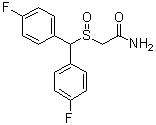 |
| Molecular Formula | C15H13F2NO2S |
| Molecular Weight | 309.33 |
| CAS Registry Number | 90280-13-0 |
| SMILES | C1=CC(=CC=C1C(C2=CC=C(C=C2)F)S(=O)CC(=O)N)F |
| Solubility | Practically insoluble (0.096 g/L) (25 °C), Calc.* |
|---|---|
| Density | 1.397±0.06 g/cm3 (20 °C 760 Torr), Calc.* |
| Melting point | 78-80 °C** |
| Boiling point | 558.7±50.0 °C 760 mmHg (Calc.)* |
| Flash point | 291.7±30.1 °C (Calc.)* |
| Index of refraction | 1.615 (Calc.)* |
| * | Calculated using Advanced Chemistry Development (ACD/Labs) Software. |
| Hazard Symbols |  GHS07 Warning Details |
|---|---|
| Risk Statements | H315-H319-H335 Details |
| Safety Statements | P261-P305+P351+P338-P302+P352 Details |
| SDS | Available |
 chemBlink Chemical Story
|
Bisfluoromodafinil is a structural relative of modafinil. Its longer name says exactly what differs: each of the two phenyl rings bears a fluorine at the position opposite attachment to the central carbon. The remainder retains the modafinil framework, including the sulfoxide and the terminal acetamide. The compound is also called CRL-40,940. A near neighbor, CRL-40,941, has a different terminal group: it is the N-hydroxyamide. The laboratory codes differ by one digit, while the structures differ by an additional oxygen at the amide nitrogen. Replacing two aromatic hydrogens with fluorines changes the mass by nearly 36 daltons. Fluorine is predominantly represented by a single stable isotope, so its signature here is a change in the mass and fragmentation of the compound rather than a bromine-like isotope doublet. Even a precise mass generally does not assign substituents to particular ring positions. Different arrangements may have the same formula. When the position matters, comparison with a characterized reference and other structural evidence becomes important. The US Food and Drug Administration reported development and validation of an analytical method for distinguishing modafinil and related compounds in a dietary supplement matrix. The work included CRL-40,940, CRL-40,941, adrafinil and an N-methyl difluoro analog. Chromatography supplies a retention time, while mass analysis supplies a characteristic ion signal. The FDA report illustrated the use of both measures, showing chromatographically resolved signals with different parent ion masses for the compounds studied. A validated method answers an identification and measurement question under defined conditions. Its existence does not by itself document the prevalence of these substances in commercial samples. This is a useful example of what a structural analogy can and cannot do. The analogy generates candidates for an analyst to consider; it does not show that the compounds have the same action in people. The laboratory report provides direct evidence on analytical discrimination, while conclusions about clinical uses would require different studies. For this registry entry, the analytical story is much better supported than claims about therapeutic performance. References: 1. Cayman Chemical, bisfluoromodafinil SDS, CAS 90280-13-0. https://cdn.caymanchem.com/cdn/msds/19797m.pdf 2. US FDA. Development and validation of an analytical method to identify and quantitate novel modafinil analogs in dietary supplements. https://www.fda.gov/media/168579/download |
| Market Analysis Reports |