
Online Database of Chemicals from Around the World
| Hangzhou Verychem Science And Technology Co., Ltd. | China | |||
|---|---|---|---|---|
 | www.verychem.com | |||
 | +86 (571) 8816-2785 +86 13606544505 | |||
 | +86 (571) 8816-2787 | |||
 | lucy@verychem.com | |||
| Chemical manufacturer since 2004 | ||||
| chemBlink Massive supplier since 2021 | ||||
| Shanghai Sinofluoro chemicals Co., Ltd. | China | |||
|---|---|---|---|---|
| www.sinofluoro.com | |||
| +86 (21) 6427-9360 | |||
| +86 (21) 6427-8603 | |||
| simon.lv@sinofluoro.com jerry.chen@sinofluoro.com | |||
 | QQ Chat | |||
| Chemical manufacturer since 2008 | ||||
| chemBlink Standard supplier since 2008 | ||||
| Simagchem Corporation | China | |||
|---|---|---|---|---|
| www.simagchem.com | |||
| +86 13806087780 | |||
| +86 (592) 268-0237 | |||
| sale@simagchem.com | |||
| Chemical manufacturer since 2002 | ||||
| chemBlink Standard supplier since 2008 | ||||
| Shanghai Rui Yun Chemical Technology Co., Ltd. | China | |||
|---|---|---|---|---|
| www.rychemical.com.cn | |||
| +86 (21) 6726-7633 | |||
| +86 (21) 6726-7655 | |||
| sales@rychemical.com.cn | |||
 | WeChat: 13917251563 | |||
| Chemical manufacturer since 2009 | ||||
| chemBlink Standard supplier since 2009 | ||||
| Alfa Chemistry | USA | |||
|---|---|---|---|---|
| www.alfa-chemistry.com | |||
| +1 (516) 734-6573 | |||
| +1 (516) 927-0118 | |||
| support@alfa-chemistry.com | |||
| Chemical manufacturer since 2005 | ||||
| chemBlink Standard supplier since 2012 | ||||
| Hangzhou Leap Chem Co., Ltd. | China | |||
|---|---|---|---|---|
| www.leapchem.com | |||
| +86 (571) 8771-1850 | |||
| market19@leapchem.com | |||
| QQ Chat | |||
| Chemical manufacturer since 2006 | ||||
| chemBlink Standard supplier since 2015 | ||||
| Shanghai Qinba Chemical Co., Ltd. | China | |||
|---|---|---|---|---|
| www.shangfluoro.com | |||
| +86 (21) 6517-0832 +86 17301729617 | |||
| +86 (21) 6517-0832 | |||
| shangfluoro@hotmail.com | |||
| QQ Chat | |||
 | Skype Chat | |||
| Chemical distributor since 2011 | ||||
| chemBlink Standard supplier since 2017 | ||||
| P and M Invest Ltd. | Russia | |||
|---|---|---|---|---|
| www.fluorine.ru | |||
| +7 (495) 135-6494 | |||
| +7 (495) 135-6509 | |||
| sales@fluorine1.ru | |||
| Chemical manufacturer | ||||
| Classification | Chemical reagent >> Organic reagent >> Ester |
|---|---|
| Name | Methyl 2,2,3,3-tetrafluoro-3-methoxypropionate |
| Molecular Structure | 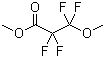 |
| Molecular Formula | C5H6F4O3 |
| Molecular Weight | 190.09 |
| CAS Registry Number | 755-73-7 |
| EC Number | 212-048-1 |
| SMILES | COC(=O)C(C(OC)(F)F)(F)F |
| Density | 1.331 |
|---|---|
| Boiling point | 159 °C |
| Refractive index | 1.3327 |
| Flash point | 48 °C |
| Hazard Symbols |  GHS02 Warning Details GHS02 Warning Details | ||||||||
|---|---|---|---|---|---|---|---|---|---|
| Risk Statements | H226 Details | ||||||||
| Safety Statements | P210-P233-P240-P241-P242-P243-P280-P303+P361+P353-P370+P378-P403+P235-P501 Details | ||||||||
| Hazard Classification | |||||||||
| |||||||||
| SDS | Available | ||||||||
 chemBlink Chemical Story
|
Methyl 2,2,3,3-tetrafluoro-3-methoxypropionate is a fluorinated organic compound with the formula C₇H₇F₄O₃. Its distinctive chemical structure, which includes both tetrafluoro and methoxy groups, imparts unique properties that make it valuable in various applications. The discovery of methyl 2,2,3,3-tetrafluoro-3-methoxypropionate is attributed to advances in fluorine chemistry, which began gaining prominence in the mid-20th century. Researchers aimed to develop fluorinated compounds with specific reactivity and stability characteristics. The synthesis of this compound was driven by the need for materials with enhanced performance in chemical reactions and industrial processes. In industrial applications, methyl 2,2,3,3-tetrafluoro-3-methoxypropionate is primarily used as a specialty reagent. Its high fluorine content contributes to its low reactivity and high chemical stability, making it ideal for use in environments where such properties are critical. It is employed in various chemical synthesis processes, particularly where fluorinated compounds are desired for their unique characteristics. One notable application of this compound is in the synthesis of pharmaceuticals and agrochemicals. The fluorinated nature of the molecule imparts specific electronic and steric effects that can enhance the activity of drug molecules or improve their interaction with biological targets. This makes it a useful intermediate in the production of compounds with tailored biological properties. Additionally, methyl 2,2,3,3-tetrafluoro-3-methoxypropionate is utilized in the development of advanced materials. Its chemical stability and fluorine content make it suitable for use in creating coatings, polymers, and other materials that require enhanced durability and resistance to environmental factors. Research into the environmental impact and safety of fluorinated compounds, including methyl 2,2,3,3-tetrafluoro-3-methoxypropionate, is ongoing. Understanding the persistence and potential effects of such chemicals is crucial for ensuring their safe use and mitigating any adverse environmental impact. References 2022. Asymmetric Synthesis of Giredestrant. Synfacts, 18(6). DOI: 10.1055/s-0041-1738308 |
| Market Analysis Reports |