
Online Database of Chemicals from Around the World
| Simagchem Corporation | China | |||
|---|---|---|---|---|
 | www.simagchem.com | |||
 | +86 13806087780 | |||
 | +86 (592) 268-0237 | |||
 | sale@simagchem.com | |||
| Chemical manufacturer since 2002 | ||||
| chemBlink Standard supplier since 2008 | ||||
| SRC Laboratories Pvt Ltd | India | |||
|---|---|---|---|---|
| www.srclaboratories.com | |||
| +91 (40) 2307-7999 | |||
| +91 (40) 2307-7999 | |||
| info@srclaboratories.com | |||
| Chemical manufacturer since 2009 | ||||
| chemBlink Standard supplier since 2011 | ||||
| Xuzhou Xbetop Biotechnology Co., Ltd. | China | |||
|---|---|---|---|---|
| www.xbetop.com | |||
| +86 (516) 8329-1698 | |||
| +86 (516) 8329-1698 | |||
| xbetop@gmail.com xbetop@hotmail.com | |||
 | QQ Chat | |||
| Chemical manufacturer | ||||
| chemBlink Standard supplier since 2011 | ||||
| Hangzhou Leap Chem Co., Ltd. | China | |||
|---|---|---|---|---|
| www.leapchem.com | |||
| +86 (571) 8771-1850 | |||
| market19@leapchem.com | |||
| QQ Chat | |||
| Chemical manufacturer since 2006 | ||||
| chemBlink Standard supplier since 2015 | ||||
| Cangzhou Enke Pharma-tech Co., Ltd. | China | |||
|---|---|---|---|---|
| www.enkepharma.com | |||
| +86 (317) 529-6180 510-6597 +86 15533709196 | |||
| +86 (317) 510-6596 | |||
| sale@enkepharma.com enkepharma@126.com | |||
| QQ Chat | |||
 | Skype Chat | |||
 | WeChat: ymzhao | |||
| Chemical manufacturer since 2011 | ||||
| chemBlink Standard supplier since 2016 | ||||
| Carbosynth China Ltd. | China | |||
|---|---|---|---|---|
| www.carbosynth.cn | |||
| +86 (512) 6260-5585 | |||
| +86 (512) 6260-5576 | |||
| sales@carbosynth.com | |||
| QQ Chat | |||
| Chemical manufacturer since 2006 | ||||
| chemBlink Standard supplier since 2016 | ||||
| Shanghai CR Corporation Limited | China | |||
|---|---|---|---|---|
| www.crcorporation.cn | |||
| +86 (21) 5736-6208 +86 13917420128 | |||
| +86 (21) 5736-6228 | |||
| fred.wen@crcorporation.cn | |||
| QQ Chat | |||
| Chemical manufacturer since 2016 | ||||
| chemBlink Standard supplier since 2017 | ||||
| Frinton Laboratories, Inc. | USA | |||
|---|---|---|---|---|
| www.frinton.com | |||
| +1 (856) 722-7037 | |||
| +1 (856) 439-1977 | |||
| sales@frinton.com frinton@frinton.com | |||
| Chemical manufacturer since 1963 | ||||
| Carbone Scientific Co., Ltd. | UK | |||
|---|---|---|---|---|
| www.carbonesci.com | |||
| +44 (870) 486-8629 | |||
| +44 (870) 288-7399 | |||
| sales@carbonesci.com | |||
| Chemical distributor | ||||
| Atlantic Research Chemicals Ltd. | UK | |||
|---|---|---|---|---|
| www.atlantic-chemicals.com | |||
| +44 (8707) 746-454 | |||
| +44 (8707) 746-455 | |||
| info@atlantic-chemicals.com | |||
| Chemical manufacturer | ||||
| Spectrum Info Ltd. | Ukraine | |||
|---|---|---|---|---|
| www.spec-info.com | |||
| +38 (044) 573-5462 | |||
| +38 (044) 573-2397 | |||
| spec-info@spec-info.com | |||
| Chemical manufacturer | ||||
| Apollo Scientific Ltd. | UK | |||
|---|---|---|---|---|
| www.apolloscientific.co.uk | |||
| +44 (161) 406-0505 | |||
| +44 (161) 406-0506 | |||
| sales@apolloscientific.co.uk | |||
| Chemical manufacturer | ||||
| Syn-Finechem Laboratories Pvt. Ltd. | India | |||
|---|---|---|---|---|
| www.synfinechem.com | |||
| +91 (40) 2309-5094 | |||
| +91 (40) 2319-4700 | |||
| synfine@synfinechem.com info@synfinechem.com | |||
| Chemical manufacturer since 2003 | ||||
| Anvia Chemicals, LLC | USA | |||
|---|---|---|---|---|
| www.anviachem.com | |||
| +1 (414) 534-7845 | |||
| +1 (414) 762-5539 | |||
| sales@anviachem.com | |||
| Chemical manufacturer | ||||
| Classification | Biochemical >> Amino acids and their derivatives >> Other amino acid derivatives |
|---|---|
| Name | 2-Amino-5-methoxybenzoic acid |
| Molecular Structure | 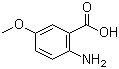 |
| Molecular Formula | C8H9NO3 |
| Molecular Weight | 167.16 |
| CAS Registry Number | 6705-03-9 |
| EC Number | 628-679-4 |
| SMILES | COC1=CC(=C(C=C1)N)C(=O)O |
| Melting point | 148-152 °C |
|---|---|
| Hazard Symbols |  GHS07 Warning Details | ||||||||||||||||||||||||
|---|---|---|---|---|---|---|---|---|---|---|---|---|---|---|---|---|---|---|---|---|---|---|---|---|---|
| Risk Statements | H302-H315-H319-H335 Details | ||||||||||||||||||||||||
| Safety Statements | P261-P264-P270-P271-P280-P301+P312-P302+P352-P304+P340-P305+P351+P338-P330-P332+P313-P337+P313-P362-P403+P233-P405-P501 Details | ||||||||||||||||||||||||
| Hazard Classification | |||||||||||||||||||||||||
| |||||||||||||||||||||||||
| SDS | Available | ||||||||||||||||||||||||
 chemBlink Chemical Story
|
2-Amino-5-methoxybenzoic acid is an organic compound belonging to the aminobenzoic acids family. Its discovery can be traced back to early 20th-century chemical research focusing on the synthesis and characterization of substituted benzoic acids. It was synthesized through the nitration and subsequent reduction of 5-methoxyaniline followed by carboxylation. The chemical structure of 2-amino-5-methoxybenzoic acid was confirmed using spectroscopic techniques such as nuclear magnetic resonance (NMR) and mass spectrometry (MS). This compound's unique structure, featuring both an amino group and a methoxy group on a benzoic acid core, makes it valuable for various applications in pharmaceuticals, chemical synthesis, and materials science. 2-Amino-5-methoxybenzoic acid is a crucial intermediate in the synthesis of various pharmaceuticals. Its unique structure allows for the creation of bioactive compounds that can target specific biological pathways. It is used to develop drugs with anti-inflammatory, analgesic, and antimicrobial properties. The amino and methoxy groups facilitate the formation of derivatives that enhance the compound's pharmacological activity and bioavailability. In organic synthesis, 2-amino-5-methoxybenzoic acid is used as a building block for more complex molecules. It participates in various reactions such as coupling, substitution, and condensation, making it valuable for creating heterocyclic compounds, dyes, and agrochemicals. Its ability to introduce functional groups into molecules makes it a versatile reagent in synthetic chemistry. The compound finds applications in materials science, particularly in the development of polymers and advanced materials. The presence of both amino and methoxy groups allows it to be incorporated into polymer backbones, enhancing properties such as thermal stability, mechanical strength, and chemical resistance. These polymers are used in coatings, adhesives, and other high-performance materials. 2-Amino-5-methoxybenzoic acid is used in academic and industrial research to study chemical reactions and develop new synthetic methodologies. Its multifunctional nature makes it an ideal candidate for exploring novel transformations and reaction mechanisms. Researchers utilize it to design new compounds with potential applications in various fields, driving innovation and expanding the frontiers of chemical science. The compound is also significant in the agrochemical industry for synthesizing herbicides, fungicides, and plant growth regulators. Its structural attributes allow for the creation of effective active ingredients that protect crops from pests and diseases, thereby improving agricultural productivity and sustainability. References 2020. Expedient Approach to the Synthesis of Betrixaban. SynOpen, 4. DOI: 10.1055/s-0040-1707267 2016. Concise Synthesis of Dictyoquinazol A via a Dimerisation-Cyclocondensation Sequence. Synlett, 27(6). DOI: 10.1055/s-0035-1561569 1972. Reaction of anthranilic acid and methoxy- and nitro-substituted anthranilic acid with p-toluenesulfonyl chloride in pyridine. Chemistry of Heterocyclic Compounds, 8(10). DOI: 10.1007/bf00475532 |
| Market Analysis Reports |