
Online Database of Chemicals from Around the World
| Hefei TNJ Chemical Industry Co., Ltd. | China | |||
|---|---|---|---|---|
 | www.tnjchem.com | |||
 | +86 (551) 6541-8684 | |||
 | +86 (551) 6541-8697 | |||
 | sales@tnjchem.com | |||
| Chemical manufacturer since 2001 | ||||
| chemBlink Standard supplier since 2010 | ||||
| Hangzhou Leap Chem Co., Ltd. | China | |||
|---|---|---|---|---|
| www.leapchem.com | |||
| +86 (571) 8771-1850 | |||
| market19@leapchem.com | |||
 | QQ Chat | |||
| Chemical manufacturer since 2006 | ||||
| chemBlink Standard supplier since 2015 | ||||
| BIT Bio-harbor, Inc. | China | |||
|---|---|---|---|---|
| www.bit-harbor.com | |||
| +86 (0411) 8457-5270 | |||
| maggy@bit-harbor.com | |||
| Chemical manufacturer since 2010 | ||||
| chemBlink Standard supplier since 2026 | ||||
| Classification | Biochemical >> Enzymes and coenzymes |
|---|---|
| Name | Endo-beta-1,4-mannanase |
| Synonyms | 15-ethyl-1-oxacyclopentadec-10-en-2-o,16-methyl-1-oxacyclohexadec-10-en-2-one,14-propyl-1-oxacyclotetradec-10-en-2-one |
| Molecular Structure | 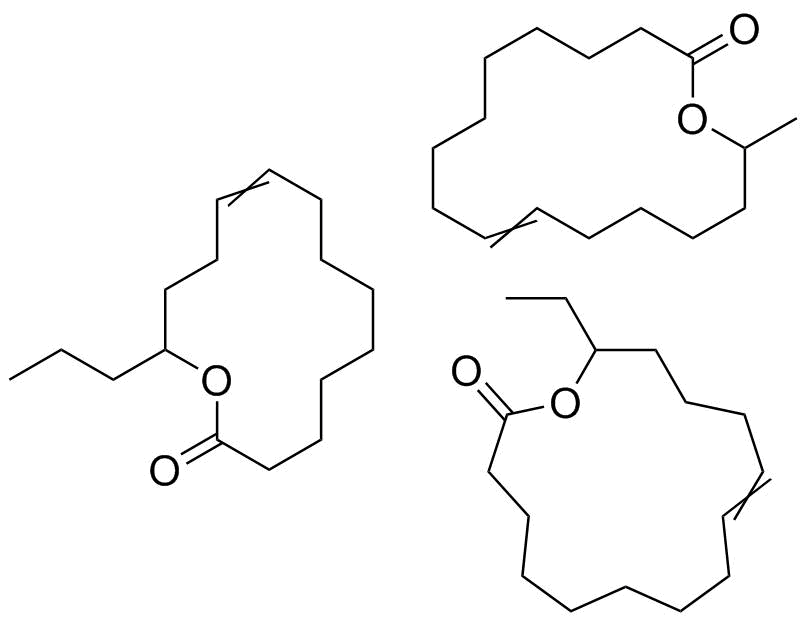 |
| Molecular Formula | C48H84O6 |
| Molecular Weight | 757.18 |
| CAS Registry Number | 37288-54-3 |
| EC Number | 253-446-5 |
| SMILES | CCCC1CCC=CCCCCCCCC(=O)O1.CCC1CCCC=CCCCCCCCC(=O)O1.CC1CCCCC=CCCCCCCCC(=O)O1 |
| Hazard Symbols |  GHS08 Danger Details GHS08 Danger Details | ||||||||
|---|---|---|---|---|---|---|---|---|---|
| Risk Statements | H334 Details | ||||||||
| Safety Statements | P233-P260-P271-P284-P304+P340-P342+P316-P403-P501 Details | ||||||||
| Hazard Classification | |||||||||
| |||||||||
 chemBlink Chemical Story
|
Endo-beta-1,4-mannanase, CAS 37288-54-3, is not a conventional small-molecule chemical but an enzyme activity found in proteins produced by many microorganisms, plants, and other organisms. It is classified as EC 3.2.1.78 and is also known as mannan endo-1,4-beta-mannosidase or beta-mannanase. Its defining function is the hydrolysis of internal beta-1,4-mannosidic bonds in mannans, galactomannans, glucomannans, and related polysaccharides. This distinction is important when interpreting the CAS number. Different beta-mannanases can have different amino-acid sequences, molecular weights, structures, temperature optima, and pH preferences while performing essentially the same type of catalytic reaction. CAS 37288-54-3 therefore identifies an enzyme activity rather than one unique molecule with a single molecular formula. Mannans are polysaccharides built largely from mannose residues linked through beta-1,4-glycosidic bonds. They occur in plant cell walls and storage materials and form an important part of the hemicellulose fraction of many plants. Depending on the source, the mannan backbone may also contain glucose or carry galactose-containing side groups, producing glucomannans, galactomannans, and galactoglucomannans. Familiar natural materials illustrate this chemistry. Guar gum and locust bean gum are rich in galactomannans, while konjac contains large amounts of glucomannan. These polymers can bind water strongly and produce highly viscous solutions, properties that make them useful as thickeners and stabilizers. Endo-beta-1,4-mannanase does essentially the opposite job. Instead of constructing a long carbohydrate chain, it cuts one apart. The word "endo" describes an important feature of the process. An exo-acting enzyme works progressively from an end of a polymer chain. An endo-mannanase attacks susceptible bonds at internal positions along the mannan backbone. A very large polysaccharide can therefore be rapidly divided into many shorter fragments. The enzyme catalyzes hydrolysis: water is used to cleave beta-1,4-glycosidic bonds between mannose residues. The products include shorter mannooligosaccharides, which can subsequently be processed by additional carbohydrate-active enzymes. In nature, combinations of such enzymes allow microorganisms to obtain nutrients from complex plant material. The chemistry is remarkably selective. A plant cell wall contains many different chemical bonds, yet the enzyme's active site recognizes particular carbohydrate structures and positions the target glycosidic bond for cleavage. This molecular recognition is one reason enzymes can perform useful transformations under comparatively mild conditions. Different organisms have evolved different versions of beta-mannanase. Enzymes have been characterized from fungi and bacteria including Aspergillus, Bacillus, Trichoderma, and many other genera. Individual enzymes can differ greatly in their preferred temperature and pH. Industrial biotechnology takes advantage of this diversity by selecting or engineering enzymes suited to particular processing conditions. One of the most familiar applications is food processing. Mannans can contribute substantial viscosity to plant extracts. Beta-mannanase can reduce polymer chain length and therefore lower viscosity. The enzyme has been investigated and used in processes involving coffee extracts and other mannan-rich plant materials. Animal nutrition provides another important application. Soybean meal, palm kernel meal, copra meal, and other plant-derived feed ingredients can contain beta-mannans that are not efficiently utilized by some animals. Supplementing feed with suitable beta-mannanase preparations can partially degrade these polysaccharides and modify the accessibility of nutrients in the feed matrix. The pulp and paper industry presents a different problem. Softwood hemicellulose contains substantial amounts of galactoglucomannan. Mannan-degrading enzymes can help modify these hemicelluloses during pulp processing and have been investigated as biological aids that can reduce the severity or chemical requirements of some processing and bleaching operations. Detergent technology offers an especially easy way to visualize the enzyme's role. Food stains may contain polysaccharide gums used as thickeners. A mannanase can cut the mannan component into smaller, more soluble fragments, helping loosen the material from a surface so that other detergent components can remove it more effectively. An even more surprising application comes from oil and gas production. Guar gum is used to create viscous fluids in hydraulic fracturing because its galactomannan chains thicken water and help carry proppant. After the fluid has served this purpose, however, excessive viscosity becomes undesirable. Thermostable beta-mannanases can act as biological breakers, cutting the guar polymer into smaller fragments and reducing viscosity. The same fundamental reaction is therefore useful in two apparently opposite industries. In food technology, a mannan may be valued because it thickens a product. In an industrial process, the same property may later become an obstacle. Beta-mannanase provides a way to switch the polymer from a high-molecular-weight thickener into much smaller carbohydrate fragments. Mannanases are also relevant to conversion of lignocellulosic biomass. Plant cell walls are complex composites of cellulose, hemicellulose, and lignin. Efficient conversion of this material into fermentable sugars generally requires mixtures of enzymes rather than a single catalyst. Mannanases help attack the mannan-containing portion of hemicellulose and can work together with cellulases and other glycoside hydrolases. This illustrates an important principle of biological decomposition. Nature rarely dismantles a plant cell wall with one molecular tool. Instead, organisms deploy collections of enzymes, each recognizing particular bonds within a complicated polymer network. Endo-beta-1,4-mannanase is therefore best understood not as one specific protein but as a biochemical function: a molecular cutting tool specialized for mannan chains. Different organisms have evolved different versions of that tool, and biotechnology has adapted them to very different industrial environments. From a cup of coffee to animal feed, paper pulp, laundry detergent, renewable biomass, and even an oil well, these applications appear to have little in common. At the molecular level, however, the task is remarkably similar in every case: find a long mannan chain, recognize its beta-1,4 linkages, and cut the chain into smaller pieces. A microscopic enzyme can therefore change a macroscopic property such as viscosity, digestibility, stain removal, or processability simply by cutting selected bonds in a carbohydrate polymer. Endo-beta-1,4-mannanase is an excellent example of how enzyme specificity turns molecular recognition into practical industrial technology. References 1. IUBMB Enzyme Nomenclature. EC 3.2.1.78. Mannan endo-1,4-beta-mannosidase. Random hydrolysis of beta-1,4-D-mannosidic linkages in mannans, galactomannans and glucomannans. https://iubmb.qmul.ac.uk/enzyme/EC3/2/1/78.html 2. Reese, E. T.; Shibata, Y. (1965). "Beta-Mannanases of Fungi." Canadian Journal of Microbiology, 11, 167-183. 3. Dhawan, S.; Kaur, J. (2007). "Microbial Mannanases: An Overview of Production and Applications." Critical Reviews in Biotechnology, 27, 197-216. 4. Srivastava, P. K.; Kapoor, M. (2017). "Production, Properties, and Applications of Endo-beta-mannanases." Biotechnology Advances, 35, 1-19. 5. Jana, U. K. et al. (2021). "Applications of Microbial beta-Mannanases." Frontiers in Bioengineering and Biotechnology, 8, 598630. https://pmc.ncbi.nlm.nih.gov/articles/PMC7770148/ |
| Market Analysis Reports |