
Online Database of Chemicals from Around the World
| Tyger Scientific Inc. | USA | |||
|---|---|---|---|---|
 | www.tygersci.com | |||
 | +1 (609) 434-0144 | |||
 | +1 (609) 434-0143 | |||
 | sales@tygersci.com | |||
| Chemical manufacturer since 1992 | ||||
| chemBlink Standard supplier since 2008 | ||||
| BOC Sciences | USA | |||
|---|---|---|---|---|
| www.bocsci.com | |||
| +1 (631) 485-4226 | |||
| +1 (631) 614-7828 | |||
| info@bocsci.com | |||
| Chemical manufacturer | ||||
| chemBlink Standard supplier since 2010 | ||||
| INA Pharmaceuticals Pvt. Ltd. | India | |||
|---|---|---|---|---|
| inapharma.in | |||
| +91 7815933367 | |||
| rd@inapharma.in | |||
| Chemical manufacturer since 2018 | ||||
| chemBlink Standard supplier since 2026 | ||||
| Combi-Blocks, Inc. | USA | |||
|---|---|---|---|---|
| www.combi-blocks.com | |||
| +1 (858) 635-8950 | |||
| +1 (858) 635-8991 | |||
| sales@combi-blocks.com | |||
| Chemical manufacturer | ||||
| Synthonix, Inc. | USA | |||
|---|---|---|---|---|
| www.synthonix.com | |||
| +1 (919) 875-9277 | |||
| +1 (919) 875-9601 | |||
| info@synthonix.com | |||
| Chemical manufacturer | ||||
| Activate Scientific GmbH | Germany | |||
|---|---|---|---|---|
| www.activate-scientific.com | |||
| +49 (8051) 965-1660 | |||
| +49 (8051) 965-1661 | |||
| rschmitt@activate-scientific.com | |||
| Chemical manufacturer | ||||
| Classification | Organic raw materials >> Heterocyclic compound >> Pyrroles |
|---|---|
| Name | 3-Amino-2-ethoxycarbonylpyrrole hydrochloride |
| Synonyms | ethyl 3-amino-1H-pyrrole-2-carboxylate;hydrochloride |
| Molecular Structure | 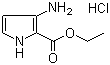 |
| Molecular Formula | C7H11ClN2O2 |
| Molecular Weight | 190.63 |
| CAS Registry Number | 252932-49-3 |
| EC Number | 801-525-5 |
| SMILES | CCOC(=O)C1=C(C=CN1)N.Cl |
| Melting point | 198 - 204 °C (Expl.) |
|---|---|
| Hazard Symbols |  GHS07 Warning Details GHS07 Warning Details | ||||||||||||||||||||||||||||
|---|---|---|---|---|---|---|---|---|---|---|---|---|---|---|---|---|---|---|---|---|---|---|---|---|---|---|---|---|---|
| Risk Statements | H302-H315-H317-H319-H335 Details | ||||||||||||||||||||||||||||
| Safety Statements | P261-P264-P264+P265-P270-P271-P272-P280-P301+P317-P302+P352-P304+P340-P305+P351+P338-P319-P321-P330-P332+P317-P333+P317-P337+P317-P362+P364-P403+P233-P405-P501 Details | ||||||||||||||||||||||||||||
| Hazard Classification | |||||||||||||||||||||||||||||
| |||||||||||||||||||||||||||||
| SDS | Available | ||||||||||||||||||||||||||||
 chemBlink Chemical Story
|
3-Amino-2-ethoxycarbonylpyrrole hydrochloride, CAS 252932-49-3, is a functionalized pyrrole used primarily as an intermediate in organic and medicinal chemistry. It is also known as ethyl 3-amino-1H-pyrrole-2-carboxylate hydrochloride. Its molecular formula is C7H11ClN2O2 and its molecular weight is 190.63. The molecule combines a pyrrole ring with two adjacent functional groups: an amino group and an ethoxycarbonyl group. This arrangement makes it particularly useful for constructing more complex fused nitrogen heterocycles. Pyrrole is one of the fundamental five-membered aromatic nitrogen heterocycles. Its nitrogen lone pair participates in the aromatic six-electron system, giving the ring electronic properties quite different from those of a conventional amine. Pyrrole structures occur widely in natural products and biological molecules, including the tetrapyrrole frameworks associated with heme, chlorophyll, and related pigments. In 3-amino-2-ethoxycarbonylpyrrole, however, the most important synthetic feature is not simply the pyrrole ring itself. The amino group at the 3-position lies immediately next to the ester at the 2-position. These neighboring functions create a preorganized arrangement of atoms that can participate in condensation and cyclization reactions. This makes the compound a useful precursor to fused bicyclic heterocycles, especially pyrrolopyrimidines. Pyrrolopyrimidines contain a five-membered pyrrole fused to a six-membered pyrimidine ring. The resulting bicyclic system is compact, planar, nitrogen-rich, and particularly important in medicinal chemistry. The reason becomes clear when pyrrolopyrimidines are compared with purines. Purines, including adenine and guanine derivatives, contain fused nitrogen heterocycles and form part of the molecular language of nucleic acids. Pyrrolopyrimidines are not identical to purines, but appropriately substituted members of this family can reproduce some of the size, shape, and hydrogen-bonding characteristics of purine systems. For this reason, pyrrolopyrimidine scaffolds have been extensively investigated in medicinal chemistry. Depending on their substitution pattern, they have appeared in research on kinase inhibitors, nucleoside-metabolism inhibitors, antiviral agents, and other biologically active compounds. The biological activity belongs to the completed derivatives, not to CAS 252932-49-3 itself. Published synthetic work provides a particularly clear example of how this small intermediate is used. 3-Amino-2-ethoxycarbonylpyrrole hydrochloride can be converted into derivatives of pyrrolo[3,2-d]pyrimidine by reaction with suitable carbon- and nitrogen-containing partners. In one documented pharmaceutical sequence, the free aminopyrrole obtained from the hydrochloride reacts with a substituted thiopseudourea derivative and subsequently undergoes cyclization to form a pyrrolo[3,2-d]pyrimidine framework. This transformation illustrates the concept of molecular preorganization. The pyrrole portion already supplies one complete ring. The adjacent amino and ester groups provide functional sites from which a second ring can be constructed. Instead of assembling an entire bicyclic heterocycle atom by atom, the chemist begins with much of the required architecture already in place. The ester group plays more than one role. Its carbonyl carbon provides an electrophilic center that can participate in ring-forming chemistry, while the ethoxy group can serve as a leaving component during appropriate condensation processes. The neighboring amino group supplies nitrogen nucleophilicity. Their close spatial relationship makes intramolecular closure into a six-membered nitrogen-containing ring chemically accessible after suitable additional atoms have been introduced. The hydrochloride form has a practical purpose as well. Free aminopyrroles can be chemically sensitive, and conversion of a basic amino group into a crystalline acid-addition salt can improve isolation, handling, and storage. Published process chemistry describes preparation of the free ethyl 3-amino-1H-pyrrole-2-carboxylate followed by treatment with hydrogen chloride to precipitate the corresponding hydrochloride. A patent describing preparation of inhibitors of nucleoside metabolism provides detailed characterization of this material. The free aminopyrrole was converted to its hydrochloride salt and recrystallized, giving material with a reported melting range of 197-200 °C together with proton and carbon-13 nuclear magnetic resonance data. Such records are useful because they establish the compound as an experimentally isolated synthetic intermediate rather than merely a structure appearing in chemical catalogs. The same intermediate has continued to appear in modern medicinal-chemistry research. Pyrrole ester starting materials of this type provide access to substituted pyrrolopyrimidines that can subsequently be modified at several positions. Once the fused bicyclic core has been formed, chemists can attach side chains, aromatic groups, heterocycles, or other functional groups to explore molecular recognition and biological activity. This approach is central to medicinal chemistry. Researchers often begin with a privileged or biologically relevant heterocyclic scaffold and systematically vary the groups around it. A relatively simple intermediate can therefore sit near the beginning of a synthetic tree that eventually branches into dozens or hundreds of candidate molecules. 3-Amino-2-ethoxycarbonylpyrrole hydrochloride is especially illustrative because its structure already hints at what it can become. The five-membered ring is complete, while the adjacent amino and ester groups form part of the chemical machinery needed to construct the neighboring six-membered ring. The compound therefore represents more than a generic heterocyclic intermediate. It is a partially preassembled fused-ring system. Several atoms of the future bicyclic skeleton are already in their required positions; chemical synthesis supplies the remaining atoms and closes the second ring. This is one of the recurring strategies that makes complex heterocyclic synthesis efficient. Rather than building complexity randomly, chemists choose starting materials whose functional groups contain information about the architecture of the intended product. In 3-Amino-2-ethoxycarbonylpyrrole hydrochloride, a small substituted pyrrole already carries that architectural information. References 1. ChemicalBook. 3-Amino-2-ethoxycarbonylpyrrole hydrochloride. CAS 252932-49-3. Molecular formula C7H11ClN2O2; molecular weight 190.63. 2. EP 2077268 A1. Process for Preparing Inhibitors of Nucleoside Metabolism. Preparation and characterization of ethyl 3-amino-1H-pyrrole-2-carboxylate hydrochloride. https://patents.google.com/patent/EP2077268A1/en 3. US 10,259,814. Pyrrolo[3,2-d]pyrimidine Derivatives for the Treatment of Viral Infections and Other Diseases. Use of 3-amino-2-ethoxycarbonylpyrrole hydrochloride in pyrrolopyrimidine synthesis. 4. Joule, J. A.; Mills, K. Heterocyclic Chemistry, 5th ed. Wiley. Chemistry of pyrroles and fused nitrogen heterocycles. 5. Medicinal chemistry literature on pyrrolo[3,2-d]pyrimidine derivatives and related nitrogen heterocyclic scaffolds. |
| Market Analysis Reports |