
Online Database of Chemicals from Around the World
| Mascot I.E. CO.,Ltd. | China | |||
|---|---|---|---|---|
 | www.mascotchem.com | |||
 | +86 (519) 8501-0339 +86 13584504415 | |||
 | +86 (519) 8501-0366 | |||
 | info@mascotchem.com | |||
 | QQ Chat | |||
| Chemical distributor since 2006 | ||||
| chemBlink Standard supplier since 2006 | ||||
| BOC Sciences | USA | |||
|---|---|---|---|---|
| www.bocsci.com | |||
| +1 (631) 485-4226 | |||
| +1 (631) 614-7828 | |||
| info@bocsci.com | |||
| Chemical manufacturer | ||||
| chemBlink Standard supplier since 2010 | ||||
| Pure Chemistry Scientific Inc | USA | |||
|---|---|---|---|---|
| www.purechems.com | |||
| +1 (888) 588-9418 | |||
| +1 (617) 206-9595 | |||
| sales@purechems.com | |||
| Chemical manufacturer since 2004 | ||||
| chemBlink Standard supplier since 2014 | ||||
| Hangzhou Leap Chem Co., Ltd. | China | |||
|---|---|---|---|---|
| www.leapchem.com | |||
| +86 (571) 8771-1850 | |||
| market19@leapchem.com | |||
| QQ Chat | |||
| Chemical manufacturer since 2006 | ||||
| chemBlink Standard supplier since 2015 | ||||
| Shanghai Forever Synthesis Co.,Ltd. | China | |||
|---|---|---|---|---|
| www.foreversyn.com | |||
| +86 (551) 6288-8437 +86 18096409024 | |||
| sales@foreversyn.com sales02@foreversyn.com | |||
| QQ Chat | |||
 | Skype Chat | |||
| Chemical distributor since 2013 | ||||
| chemBlink Standard supplier since 2018 | ||||
| Xi'an Reapsource Biotechnology Co., Ltd. | China | |||
|---|---|---|---|---|
| www.rpybiotech.com | |||
| +86 18991103357 | |||
| buyun.ping@rpybiotech.com | |||
| QQ Chat | |||
 | WeChat: 18991103357 | |||
| Chemical manufacturer since 2024 | ||||
| chemBlink Standard supplier since 2026 | ||||
| Classification | Chemical reagent >> Organic reagent >> Boric acid |
|---|---|
| Name | B-(Phenyl-2,3,4,5,6-d5)boronic acid |
| Synonyms | (Perdeuterophenyl)boronic acid |
| Molecular Structure | 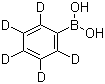 |
| Molecular Formula | C6H2BD5O2 |
| Molecular Weight | 127.08 |
| CAS Registry Number | 215527-70-1 |
| EC Number | 623-841-0 |
| SMILES | [2H]C1=C(C(=C(C(=C1[2H])[2H])B(O)O)[2H])[2H] |
| Solubility | 4417 mg/L (25 °C water) |
|---|---|
| Density | 1.1±0.1 g/cm3, Calc.* |
| Index of Refraction | 1.534, Calc.* |
| Melting point | 91.85 °C |
| Boiling Point | 265.9±23.0 °C (760 mmHg), Calc.*, 309.95 °C |
| Flash Point | 114.6±22.6 °C, Calc.* |
| * | Calculated using Advanced Chemistry Development (ACD/Labs) Software. |
| Hazard Symbols |  GHS07 Warning Details GHS07 Warning Details | ||||||||
|---|---|---|---|---|---|---|---|---|---|
| Risk Statements | H302 Details | ||||||||
| Safety Statements | P264-P270-P301+P317-P330-P501 Details | ||||||||
| Hazard Classification | |||||||||
| |||||||||
| SDS | Available | ||||||||
 chemBlink Chemical Story
|
B-(Phenyl-2,3,4,5,6-d5)boronic acid is a deuterium-labeled arylboronic acid in which the phenyl ring is fully deuterated at the five aromatic positions and bonded to a boronic acid functional group. Arylboronic acids are a well-established class of organoboron compounds widely used in synthetic organic chemistry, particularly as coupling partners in carbon–carbon bond-forming reactions. The chemistry of boronic acids became prominent in the twentieth century with the development of organoboron chemistry and its application to selective functional group transformations. Arylboronic acids are especially important due to their role in palladium-catalyzed cross-coupling reactions, most notably the Suzuki–Miyaura coupling, which enables the formation of biaryl structures under relatively mild conditions. These reactions have become foundational tools in the synthesis of pharmaceuticals, agrochemicals, and advanced organic materials. In B-(phenyl-2,3,4,5,6-d5)boronic acid, the phenyl ring is isotopically labeled with deuterium atoms at all five aromatic positions. Deuterium is a stable isotope of hydrogen containing one proton and one neutron, and its incorporation into organic molecules produces isotopologues that are chemically similar to their non-deuterated counterparts but can be distinguished by mass spectrometry and, in some cases, nuclear magnetic resonance spectroscopy. Such isotopic labeling is widely used in mechanistic studies, tracer experiments, and as internal standards in quantitative analytical methods. The boronic acid functional group consists of a trivalent boron atom bonded to two hydroxyl groups and one carbon substituent. Boron is electron-deficient and can form reversible covalent interactions with nucleophiles, including diols and heteroatoms. This property underlies the reactivity of boronic acids in both synthetic transformations and molecular recognition chemistry. In cross-coupling reactions, arylboronic acids act as nucleophilic partners that transfer the aryl group to a metal catalyst, typically palladium, in the presence of a base. The presence of deuterium labeling on the phenyl ring does not significantly alter the chemical reactivity of the arylboronic acid, but it does introduce a measurable kinetic isotope effect in certain reaction pathways involving C–H bond cleavage. This feature makes deuterated arylboronic acids useful for studying reaction mechanisms and tracking the fate of aromatic substituents during catalytic transformations. Arylboronic acids are generally stable compounds but can undergo protodeboronation under strongly basic or high-temperature conditions. The stability of these compounds is influenced by substituents on the aromatic ring and reaction conditions. Deuteration typically enhances analytical utility without substantially changing the underlying chemical behavior of the boronic acid functionality. From a physicochemical perspective, B-(phenyl-2,3,4,5,6-d5)boronic acid is expected to be a polar, crystalline solid with moderate solubility in polar organic solvents and limited solubility in nonpolar media. The boronic acid group contributes to hydrogen bonding and reversible association with water, while the aromatic ring provides hydrophobic character. Deuterium substitution has minimal impact on bulk solubility but can influence vibrational properties and spectroscopic signatures. In synthetic chemistry, deuterated arylboronic acids are often used as labeled reagents in cross-coupling reactions to introduce isotopic labels into biaryl structures. They are also employed in analytical chemistry as internal standards for mass spectrometric quantification, where the mass shift provided by deuterium allows for accurate differentiation from non-labeled analogues. The development of boronic acid chemistry has significantly expanded the toolkit available for constructing complex aromatic systems. The combination of boron reactivity and palladium catalysis has enabled highly efficient and selective bond formation strategies that are widely used in modern chemical synthesis. Overall, B-(phenyl-2,3,4,5,6-d5)boronic acid is a deuterium-labeled arylboronic acid used primarily as a synthetic intermediate and analytical tool. Its significance lies in the combination of boronic acid reactivity in cross-coupling chemistry and isotopic labeling for mechanistic studies and quantitative analysis in organic and medicinal chemistry. |
| Market Analysis Reports |