
Online Database of Chemicals from Around the World
| Discovery Fine Chemicals Ltd. | UK | |||
|---|---|---|---|---|
 | www.discofinechem.com | |||
 | +44 (1202) 874-517 | |||
 | +44 (845) 094-4385 | |||
 | pjc@discofinechem.com | |||
| Chemical manufacturer | ||||
| chemBlink Standard supplier since 2009 | ||||
| Jiangxi Chibang Pharmaceutical Co., Ltd. | China | |||
|---|---|---|---|---|
| www.cbpharm.com | |||
| +86 (796) 366-6787 | |||
| +86 (796) 366-6799 | |||
| sales1@cbpharm.com india@cbpharm.com | |||
| Chemical manufacturer | ||||
| chemBlink Standard supplier since 2009 | ||||
| Amadis Chemical Co., Ltd. | China | |||
|---|---|---|---|---|
| www.amadischem.com | |||
| +86 (571) 8992-5085 | |||
| +86 (571) 8992-5065 | |||
| sales@amadischem.com | |||
| Chemical manufacturer since 2010 | ||||
| chemBlink Standard supplier since 2015 | ||||
| INA Pharmaceuticals Pvt. Ltd. | India | |||
|---|---|---|---|---|
| inapharma.in | |||
| +91 7815933367 | |||
| rd@inapharma.in | |||
| Chemical manufacturer since 2018 | ||||
| chemBlink Standard supplier since 2026 | ||||
| Shanghai Cainorise Chemicals Co., Ltd. | China | |||
|---|---|---|---|---|
| www.cainorise.com.cn | |||
| +86 (21) 3408-0216 2950-8524 +86 15921434758 | |||
| sales@cainorise.com.cn | |||
| Chemical manufacturer | ||||
| Epsilon Chimie Chemical Manufacturer | France | |||
|---|---|---|---|---|
| www.epsilon-chimie.com | |||
| +33 (2) 9842-4650 | |||
| +33 (2) 9842-4402 | |||
| pierre.cornec@epsilon-chimie.com | |||
| Chemical manufacturer | ||||
| Santa Cruz Biotechnology, Inc. | USA | |||
|---|---|---|---|---|
| www.scbt.com | |||
| +1 (831) 457-3800 | |||
| +1 (831) 457-3801 | |||
| scbt@scbt.com | |||
| Chemical manufacturer | ||||
| Wako Pure Chemical Industries, Ltd. | Japan | |||
|---|---|---|---|---|
| www.wako-chem.co.jp | |||
| +81 (6) 6203-3741 | |||
| +81 (6) 6201-5964 | |||
| wkhk.info@fujifilm.com | |||
| Chemical manufacturer since 1922 | ||||
| Classification | Chemical reagent >> Organic reagent >> Phosphorus halide |
|---|---|
| Name | (Carbomethoxymethyl)triphenylphosphonium bromide |
| Synonyms | CMMTPPB |
| Molecular Structure | 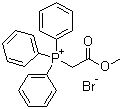 |
| Molecular Formula | C21H20BrO2P |
| Molecular Weight | 415.26 |
| CAS Registry Number | 1779-58-4 |
| EC Number | 217-222-0 |
| SMILES | COC(=O)C[P+](C1=CC=CC=C1)(C2=CC=CC=C2)C3=CC=CC=C3.[Br-] |
| Melting point | 172 °C (Decomposes) (Expl.) |
|---|---|
| Hazard Symbols |  GHS07 Warning Details GHS07 Warning Details | ||||||||||||||||
|---|---|---|---|---|---|---|---|---|---|---|---|---|---|---|---|---|---|
| Risk Statements | H315-H319-H335 Details | ||||||||||||||||
| Safety Statements | P261-P264-P264+P265-P271-P280-P302+P352-P304+P340-P305+P351+P338-P319-P321-P332+P317-P337+P317-P362+P364-P403+P233-P405-P501 Details | ||||||||||||||||
| Hazard Classification | |||||||||||||||||
| |||||||||||||||||
| SDS | Available | ||||||||||||||||
 chemBlink Chemical Story
|
(Carbomethoxymethyl)triphenylphosphonium bromide, CAS 1779-58-4, is an organophosphorus salt used primarily as a reagent for carbon-carbon bond formation in organic synthesis. It is also known as (methoxycarbonylmethyl)triphenylphosphonium bromide or (2-methoxy-2-oxoethyl)triphenylphosphonium bromide. Its molecular formula can be represented as C21H20BrO2P and its molecular weight is 415.26. Structurally, the compound consists of a triphenylphosphonium center bearing a methoxycarbonylmethyl group, with bromide as the counterion. The compound belongs to an important family of phosphonium salts associated with the Wittig reaction, one of the landmark methods of twentieth-century organic synthesis. The Wittig reaction converts the carbonyl group of an aldehyde or ketone into a carbon-carbon double bond. Instead of merely modifying an existing functional group, the reaction creates a new C=C bond and therefore provides a direct method for constructing the carbon skeleton of a molecule. (Carbomethoxymethyl)triphenylphosphonium bromide is not normally the species that performs the olefination directly. Treatment with a suitable base removes a proton from the carbon adjacent to phosphorus and generates the corresponding phosphorus ylide, commonly written as methyl (triphenylphosphoranylidene)acetate, Ph3P=CHCO2Me. Because the ylide carbon is also adjacent to an ester group, this reagent belongs to the stabilized class of Wittig ylides. The presence of the ester group is particularly important. When the ylide reacts with an aldehyde, the product is generally an α,β-unsaturated methyl ester. In simplified form, an aldehyde R-CHO can be transformed into R-CH=CH-CO2Me. The reaction therefore does two things at once: it replaces the carbonyl oxygen with a carbon-carbon double bond and extends the original carbon framework by a two-carbon ester-containing unit. This transformation is often described as olefination. It is valuable because α,β-unsaturated esters are versatile intermediates in their own right. Their conjugated C=C and carbonyl groups can participate in hydrogenation, conjugate addition, cycloaddition, reduction, oxidation, and many other transformations. A Wittig step can therefore create not only a new carbon-carbon bond but also a platform for several subsequent reactions. Stabilized ylides also have characteristic stereochemical behavior. In many reactions with aldehydes, ester-stabilized phosphorus ylides favor formation of the E alkene, although the actual E/Z ratio depends on substrate structure and reaction conditions. Published examples using methoxycarbonylmethyltriphenylphosphonium salts have produced mixtures enriched in E-configured cinnamate-type products. The reagent itself can be prepared by a straightforward quaternization reaction. Triphenylphosphine reacts with methyl bromoacetate, and the phosphorus atom displaces bromide from the bromoacetate carbon. The resulting phosphonium bromide often precipitates as a white solid. Published preparations report formation of the salt in very high or near-quantitative yield, illustrating how a simple substitution reaction can create a reagent capable of much more elaborate carbon-carbon bond construction. The next step reveals why phosphonium salts are so useful. The carbon between the positively charged phosphonium group and the ester carbonyl has relatively acidic hydrogens. A base can remove one of these protons, generating the ylide. The resulting structure is stabilized by the neighboring ester group and can then react with carbonyl compounds. Mechanistically, the Wittig reaction is remarkable because phosphorus provides the driving force for replacing oxygen with carbon. The ylide and carbonyl compound form new bonds through a sequence commonly represented by betaine and oxaphosphetane intermediates. Fragmentation ultimately produces the alkene together with triphenylphosphine oxide. Formation of the strong phosphorus-oxygen bond is a major thermodynamic feature of the process. The importance of this chemistry was recognized at the highest level. Georg Wittig shared the 1979 Nobel Prize in Chemistry with Herbert C. Brown for work involving phosphorus- and boron-containing compounds in organic synthesis. The reaction bearing Wittig's name became one of the standard tools for placing carbon-carbon double bonds at defined positions in complex molecules. CAS 1779-58-4 has been used in diverse synthetic programs. Commercial literature records applications in the preparation of GSK-3 inhibitor candidates through Wittig chemistry, substituted furanones investigated for biological activity, photochromic dithienylethene derivatives, and intermediates used in more elaborate cyclization sequences. These examples illustrate the reagent's breadth: the same phosphonium salt can participate in pharmaceutical, heterocyclic, and materials-oriented synthesis. A useful feature of the reagent is that it separates storage from reactivity. The phosphonium bromide is an isolable crystalline salt, whereas the corresponding ylide is the reactive carbon-transfer species required for olefination. Chemists can therefore store and handle the precursor and generate the reactive ylide when needed. In some procedures, ylide formation and reaction with the aldehyde can even be performed sequentially in the same reaction vessel. This distinction also explains why the compound should not simply be described as an ester-containing intermediate. Most of its triphenylphosphonium framework is not intended to remain in the desired product. The three phenyl groups and phosphorus ultimately leave as triphenylphosphine oxide. What matters synthetically is the small carbon fragment that the reagent delivers and the new double bond it helps create. (Carbomethoxymethyl)triphenylphosphonium bromide therefore represents a different kind of building block. Many synthetic intermediates become recognizable pieces of the final molecule. This reagent instead acts more like a molecular construction tool: it temporarily organizes atoms so that a new carbon-carbon bond can be made, transfers the required carbon fragment, and then discards much of its own structure. That is one reason Wittig chemistry remains conceptually elegant decades after its discovery. A large phosphorus-containing reagent can be used to accomplish a precise change at a small carbonyl group: remove oxygen from the final carbon framework, add carbon, and create a double bond exactly where the synthetic plan requires it. References 1. Sigma-Aldrich. (Methoxycarbonylmethyl)triphenylphosphonium bromide. CAS 1779-58-4. Molecular weight 415.26; reaction suitability: C-C bond formation. 2. Wittig, G.; Haag, W. (1955). "Uber Triphenyl-phosphinmethylene als olefinbildende Reagenzien." Chemische Berichte, 88, 1654-1666. 3. Maryanoff, B. E.; Reitz, A. B. (1989). "The Wittig Olefination Reaction and Modifications Involving Phosphoryl-Stabilized Carbanions. Stereochemistry, Mechanism, and Selected Synthetic Aspects." Chemical Reviews, 89, 863-927. 4. Byrne, P. A.; Gilheany, D. G. (2013). "The modern interpretation of the Wittig reaction mechanism." Chemical Society Reviews, 42, 6670-6696. 5. Nobel Prize. The Nobel Prize in Chemistry 1979: Herbert C. Brown and Georg Wittig. 6. Chemical synthesis records for CAS 1779-58-4 describing preparation from methyl bromoacetate and triphenylphosphine and subsequent formation of methyl (triphenylphosphoranylidene)acetate. |
| Market Analysis Reports |