
Online Database of Chemicals from Around the World
| Hangzhou Verychem Science And Technology Co., Ltd. | China | |||
|---|---|---|---|---|
 | www.verychem.com | |||
 | +86 (571) 8816-2785 +86 13606544505 | |||
 | +86 (571) 8816-2787 | |||
 | lucy@verychem.com | |||
| Chemical manufacturer since 2004 | ||||
| chemBlink Massive supplier since 2021 | ||||
| Classification | Chemical reagent >> Organic reagent >> Epoxide |
|---|---|
| Name | 2-Butyl-2-ethyloxirane |
| Molecular Structure | 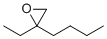 |
| Molecular Formula | C8H16O |
| Molecular Weight | 128.21 |
| CAS Registry Number | 1436-35-7 |
| EC Number | 884-845-8 |
| SMILES | CCCCC1(CO1)CC |
| Hazard Classification | |||||||||
|---|---|---|---|---|---|---|---|---|---|
| |||||||||
 chemBlink Chemical Story
|
2-Butyl-2-ethyloxirane is a substituted epoxide that illustrates one of the most important concepts in modern organic chemistry: the exceptional synthetic versatility of strained three-membered rings. Although it is not a widely recognized commercial product, this compound serves as a valuable intermediate for the preparation of alcohols, diols, amino alcohols, ethers, and numerous specialty organic molecules. Its scientific importance lies not in its individual applications but in the broader role that epoxides have played in expanding the synthetic toolbox available to chemists. Epoxides, also known as oxiranes, are among the smallest heterocyclic compounds, consisting of a three-membered ring containing two carbon atoms and one oxygen atom. The unusual geometry of this ring creates significant angle strain, making epoxides considerably more reactive than ordinary ethers. During the twentieth century, chemists recognized that this stored ring strain could be exploited as a controlled driving force for chemical reactions. Ring opening allows the formation of more stable products under relatively mild conditions, providing an efficient route to molecular complexity. The development of epoxide chemistry transformed synthetic methodology. Depending on the reaction conditions and the choice of nucleophile, epoxides can react with water, alcohols, amines, thiols, organometallic reagents, and many other nucleophiles. These reactions produce a wide range of functionalized molecules while often preserving excellent control over regioselectivity and stereochemistry. Because of this remarkable versatility, epoxides became indispensable intermediates in pharmaceutical synthesis, agrochemical development, polymer chemistry, and natural product synthesis. Substituted epoxides such as 2-butyl-2-ethyloxirane offer additional opportunities for molecular design. The alkyl substituents influence both steric and electronic effects, allowing chemists to investigate how molecular structure affects reaction pathways and product distributions. Such compounds are frequently employed as model substrates in studies of ring-opening mechanisms and as practical intermediates for constructing more elaborate carbon frameworks. Their relatively compact structures make them convenient building blocks for introducing branched alkyl fragments into larger molecules. The chemistry of epoxide ring opening also contributed significantly to the development of stereoselective synthesis. Because nucleophilic attack proceeds through well-defined mechanisms, epoxides have long served as valuable intermediates for controlling the three-dimensional arrangement of atoms in complex organic molecules. This capability became increasingly important as medicinal chemistry recognized that molecular stereochemistry often determines biological activity. Consequently, epoxide chemistry has become closely associated with the broader evolution of modern asymmetric synthesis. Beyond small-molecule synthesis, epoxides have had an enormous industrial impact through epoxy resin technology. Although simple substituted oxiranes such as 2-butyl-2-ethyloxirane are distinct from the large-scale monomers used in commercial epoxy resins, they belong to the same chemical family whose unique ring-opening chemistry underlies high-performance adhesives, protective coatings, electronic encapsulants, and advanced composite materials. The remarkable success of epoxy materials further illustrates how the reactivity of the strained oxirane ring has influenced both laboratory synthesis and industrial manufacturing. The scientific significance of 2-butyl-2-ethyloxirane therefore extends beyond its role as a synthetic intermediate. It represents the enduring importance of epoxide chemistry as one of the fundamental strategies for molecular construction. By transforming the stored energy of a strained three-membered ring into highly selective chemical reactions, epoxides have enabled generations of chemists to build increasingly sophisticated molecules. This simple oxirane serves as a reminder that some of the most powerful ideas in chemistry arise not from molecular complexity, but from understanding how a small structural feature can unlock an extraordinary range of chemical transformations. References 1. Parker, R. E.; Isaacs, N. S. (1959). "Mechanisms of Epoxide Reactions." Chemical Reviews, 59(4), 737–799. https://doi.org/10.1021/cr50028a006 2. Smith, J. G. (1984). "Synthetically Useful Reactions of Epoxides." Synthesis, 1984, 629–656. https://doi.org/10.1055/s-1984-30931 3. Carey, F. A.; Sundberg, R. J. Advanced Organic Chemistry, Part B: Reactions and Synthesis. 5th ed. Springer, 2007. |
| Market Analysis Reports |