
Online Database of Chemicals from Around the World
| Simagchem Corporation | China | |||
|---|---|---|---|---|
 | www.simagchem.com | |||
 | +86 13806087780 | |||
 | +86 (592) 268-0237 | |||
 | sale@simagchem.com | |||
| Chemical manufacturer since 2002 | ||||
| chemBlink Standard supplier since 2008 | ||||
| BOC Sciences | USA | |||
|---|---|---|---|---|
| www.bocsci.com | |||
| +1 (631) 485-4226 | |||
| +1 (631) 614-7828 | |||
| info@bocsci.com | |||
| Chemical manufacturer | ||||
| chemBlink Standard supplier since 2010 | ||||
| Wuxi Honor Shine Chemical Co., Ltd. | China | |||
|---|---|---|---|---|
| www.honorshinechem.com | |||
| +86 (510) 8359-3736 | |||
| +86 (510) 8357-4932 | |||
| sales@honorshinechem.com | |||
| Chemical distributor since 2013 | ||||
| chemBlink Standard supplier since 2014 | ||||
| Yigyooly Enterprise Limited | China | |||
|---|---|---|---|---|
| www.yigyooly.com | |||
| +86 18907980616 | |||
| agio@yigyooly.com | |||
| Chemical distributor since 2016 | ||||
| chemBlink Standard supplier since 2020 | ||||
| Zibo Jiulong Chemical Co., Ltd. | China | |||
|---|---|---|---|---|
| www.jiulongchem.cn | |||
| +86 17379678117 | |||
| +86 (0533) 607-6766 | |||
| cassie.lu@jiulongchem.cn | |||
| Chemical manufacturer since 2016 | ||||
| chemBlink Standard supplier since 2024 | ||||
| Vevau Molsieve | China | |||
|---|---|---|---|---|
| puremolsieve.com | |||
| +86 (199) 2473-6346 | |||
| jgyc3812@agent.qq.com | |||
 | WhatsApp:+86 199 2473 6346 | |||
| Chemical manufacturer since 2011 | ||||
| chemBlink Standard supplier since 2026 | ||||
| Alfa Aesar. | USA | |||
|---|---|---|---|---|
| www.alfa.com | |||
| +1 (978) 521-6300 | |||
| +1 (978) 521-6350 | |||
| info@alfa.com | |||
| Chemical manufacturer | ||||
| Classification | Inorganic chemical industry >> Inorganic salt >> Silica gel |
|---|---|
| Name | Aluminosilicate |
| Synonyms | Zeolites; Molecular sieve |
| Molecular Structure | 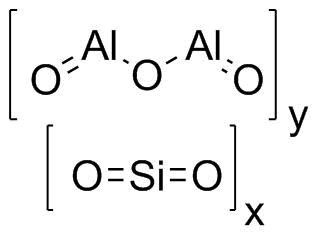 |
| Molecular Formula | (SiO2)x(Al2O3)y |
| CAS Registry Number | 1318-02-1 |
| EC Number | 215-283-8 |
| SMILES | [Si](=O)=O.[Al](=O)O[Al]=O |
| Density | 0.7 - 0.75 g/mL (Expl.) |
|---|---|
| Melting point | >1600 °C (Expl.) |
| Hazard Symbols |  Xn Details | ||||||||||||||||||||||||||||||||||||||||||||||||||||||||
|---|---|---|---|---|---|---|---|---|---|---|---|---|---|---|---|---|---|---|---|---|---|---|---|---|---|---|---|---|---|---|---|---|---|---|---|---|---|---|---|---|---|---|---|---|---|---|---|---|---|---|---|---|---|---|---|---|---|
| Risk Statements | R20;R36/37 Details | ||||||||||||||||||||||||||||||||||||||||||||||||||||||||
| Safety Statements | S26;S36;S7/9 Details | ||||||||||||||||||||||||||||||||||||||||||||||||||||||||
| Hazard Classification | |||||||||||||||||||||||||||||||||||||||||||||||||||||||||
| |||||||||||||||||||||||||||||||||||||||||||||||||||||||||
| SDS | Available | ||||||||||||||||||||||||||||||||||||||||||||||||||||||||
 chemBlink Chemical Story
|
A material name can identify a family of structures rather than a single molecule. This distinction is essential for the entry Aluminosilicate, CAS 1318-02-1, supplied here with the Chinese name for zeolite. Aluminosilicates are a broad class, while zeolites are a structurally defined group within porous inorganic materials. The general entry does not by itself establish a particular zeolite framework, cation form, composition, or pore opening. In an aluminosilicate zeolite, silicon-oxygen and aluminum-oxygen tetrahedra connect into an extended framework. Replacing a silicon center with aluminum changes the framework charge, which is balanced by additional cations. Water and other guest species can occupy available spaces. The result is not simply a collection of isolated molecules with one universally applicable molecular weight. The distinction between framework and contents creates several useful forms of chemistry. Changing exchangeable cations can alter the environment within a framework without requiring the entire network to be rebuilt. Removing adsorbed water under appropriate conditions can make space available for other guests. These processes involve both the architecture of the solid and the species occupying its internal sites. Molecular-sieve behavior is one important consequence. A porous solid can distinguish guests through accessibility and adsorption interactions. A molecule may fit through an opening yet interact differently from another molecule of comparable size, so separation is not determined by a ruler alone. Framework geometry, cation identity, water content, and the composition of the mixture can all influence what is retained. Synthetic zeolites made these ideas into reproducible materials chemistry. A 1956 paper by Breck and colleagues characterized a new synthetic material, zeolite Type A. That named framework is a concrete historical example, not a designation that can be assigned to every product carrying a broad aluminosilicate or zeolite CAS entry. Different framework types have different arrangements and must be identified separately. Ion exchange provides another application principle. Cations associated with a negatively charged framework can exchange with suitable ions in a surrounding liquid. This makes zeolite chemistry relevant to selected adsorption and water-treatment tasks. It does not mean that every material removes every contaminant equally, or that an unspecified powder has a guaranteed exchange capacity. Composition and actual measurements determine the claim that can be made. Catalysis introduces still another layer. Particular framework compositions and charge-balancing forms can create acid sites or accommodate catalytic species. An adsorption material and an acid catalyst may therefore share a structural family while serving different functions. Their performance depends on their prepared state, not just on the common word aluminosilicate. The word adsorption is also useful here. Guests interact with surfaces, including surfaces inside accessible pores, rather than simply dissolving throughout a uniform bulk liquid. The outside particle size and the internal pore opening describe different length scales. Grinding a material into smaller particles does not by itself establish a new framework aperture, although it can change the distances involved in transport. A useful specification should therefore avoid treating particle dimensions as a substitute for pore characterization. The International Zeolite Association's structure database organizes framework types using structural descriptions and crystallographic evidence. That approach illustrates what a useful material specification needs beyond a general name: framework information, chemical composition, relevant cations, and the physical form supplied. For a broad database entry, the most accurate story is therefore the underlying materials concept. A connected inorganic network becomes useful because its internal architecture and exchangeable contents can be selected and characterized, while the exact performance of an individual product remains a question for its specific identity and testing. References: 1. Sigma-Aldrich. Zeolite / Aluminosilicate, CAS 1318-02-1; product 96096. https://www.sigmaaldrich.com/US/en/product/sigma/96096 2. International Zeolite Association, Structure Commission. Database of Zeolite Structures. https://www.iza-structure.org/databases/ 3. Breck DW et al. Crystalline Zeolites. I. The Properties of a New Synthetic Zeolite, Type A. J Am Chem Soc. 1956;78:5963-5972. https://doi.org/10.1021/ja01604a001 |
| Market Analysis Reports |